
BoykoNapier, PLLC

  • Home
  • Practice Areas
    • Family Law / Divorce
      • Divorce
        • Contested vs. Uncontested Divorce
        • Separation Agreements
        • Spousal Support / Alimony
      • Child Custody, Visitation and Support
      • Adoption
      • Modification of Orders
      • Protective Orders
      • Premarital and Postmarital Agreements
      • Annulments
      • Qualified Domestic Relations Orders
      • Relocation Custody Cases
      • Grandparent and Third-Party Custodial Rights
    • Mediation: Divorce, Custody, Support
    • Criminal Defense / Traffic Defense
      • DUI / DWI, Driving Under the Influence
      • Drug Possession and Drug Distribution
      • Assault and Battery / Malicious Wounding
      • Larceny and Embezzlement
      • Reckless Driving
      • Juvenile Criminal Defense
      • Traffic Violations and License Suspensions
      • Expungement
  • Attorneys
    • Marc A. Boyko
    • Mary A. Napier
    • J. Ryan Ferry
    • Wallace “Woody” Gram
    • Mary C. Heffley, Paralegal
  • About Us
    • Why Choose Us
    • Fees and Costs
  • Blog
    • Resources
  • Contact

Call: 804-658-3418

Difficulties in Divorce: Filing Your Tax Returns

February 14, 2014 By Marc Leave a Comment

Snowday

It’s that time of year: Tax Time!

Each year, as the dreadful deadline of April 15 approaches, we are confronted with questions from clients about how they should deal with filing taxes.   These inquiries are so common we thought it might be beneficial to post a few bits of information in order to highlight some issues that frequently arise.  Please note:  you should be sure to speak directly with your tax-advisor or attorney for specific advice regarding your tax filings.


Situation A: Separated, but not yet Divorced. 

  • Do I file jointly or separately?
  • Who claims mortgage interest deductions?
  • Who claims the children?

These are very good questions.  If you have a current custody and/or support order, or a property settlement agreement, be sure to check whether these issues are addressed.  It is common for court orders and agreements to address all of these issues, as it makes the process of filing taxes easier on both spouses.  It would also be wise to consult the Internal Revenue Service’s website, as it answers a lot of common questions.

It is important to speak with your tax-advisor or attorney before deciding whether to file jointly or separately.  Often times, it will make more financial sense to file jointly because of the tax benefits—however, a joint filing can create arguments over how to divide the tax return.  It is common for the tax refund to be held in escrow by your attorney until you and your spouse can agree on the division of the refund.  If your spouse claims a deduction (i.e. mortgage interest, children) that you believe you might be entitled to, it would be wise to immediately consult an attorney or tax-advisor.

Situation B: Separated part of the year, Final Decree of Divorce entered in the tax year.

  • Do I have to file jointly?
  • Can I file separately?

Again, great questions.  If this situation applies to you, we strongly suggest you refer to the Internal Revenue Service’s website and the Virginia Department of Taxation website.  If your divorce was finalized, be sure to double check your divorce decree to determine if these issues are addressed.

Can I be held liable for my soon to be ex-spouse’s tax debt?

Maybe!  If your husband or wife has tax debt/liens which you are aware of, be sure to bring this to your attorney’s attention.  If you have already filed and the IRS has put you on notice that a portion or all of your tax return will be deducted for your ex-spouse’s tax debt, contact an attorney right away.  You should also refer to the Innocent Spouse Relief information through the IRS website.  You can apply to be held harmless from your spouse’s tax debt under certain circumstances.

If you have additional questions, please contact the attorneys at BoykoNapier.  Our Virginia family law and divorce lawyers handle cases throughout Central Virginia, including Richmond, Henrico, Chesterfield, Hanover and the surrounding communities.  Please call us at (804) 658-3418, or contact us via email.
 

Filed Under: Family Law Tagged With: Client Concerns, Divorce, Domestic Relations, Experienced Attorney, Family Law, Separation, Tax Returns, Virginia

5 Reasons Why You Should Have a WILL

July 18, 2013 By Marc Leave a Comment

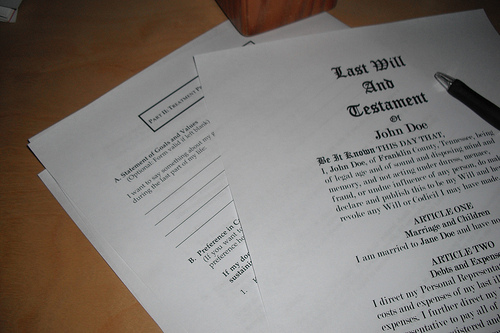
Will
Courtesy of Ken_Mayer via flickr.com

A quick surveillance of various online sources reveals a shocking, yet unsurprising fact: most people do not have a Will.

Despite the general consensus that a Will is one of the most important documents that an adult should have, most avoid the idea of contemplating death and associate having a Will with just that–death.  Even though our eventual passing is inevitable, for some reason writing down our postmortem wishes is unnerving.

But . . . this fear needs to be confronted and beaten down.  For the sake of our families and loved ones, we need to have Wills.  Especially in this day and age when lawsuits are plentiful and Wills are inexpensive to obtain in Virginia.  Here are a few simple reasons why you should have a Will:

1. A Will protects your estate from being the foundation for unnecessary and unwanted family turmoil.

  • There is much uncertainty in the minds of friends and family when a loved one passes.  While the emotional concerns are always overwhelming, so too are the monetary concerns.  And often, as you have undoubtedly seen or read about, families take to the Courtrooms to battle over estate distribution.
  • While a Will does not eliminate the possibility of family feuds, it is certainly a deterrent.  With a Will you are telling your heirs what your wishes are, and asking them to honor those wishes.  This is particularly important in situations where there are mixed family dynamics—i.e. children from separate relationships.

2. A Will gives you the power to determine who will look after your minor children, and their finances.

  • Every parent with a minor child should have a will—end of story (especially, persons who are married and have children from a separate relationship, regardless of age).  Nominate your predecessor, don’t leave it to chance.
  • While Americans often appoint “godparents”, it is not often written in legal stone.  A Will can help clarify your wishes as it pertains to care for your children—not just physically, but financially as well.

3. A Will gives you the power to choose who will handle the distribution of your estate.

  • Frequently in dispute is which heir should help administrate an estate when there is no Will.  This is problematic in families where the living heirs have strained relationships.
  • A Will gives you the opportunity to nominate the person (or persons) you’d like to be executor of your will—the person you trust to ensure that your wishes are carried out.

4. A Will gives you the power to provide financial support to multiple generations.

  • If you die without a Will, the intestacy laws in Virginia will operate to dictate the distribution of your estate.  Your heirs have no ability to creatively distribute your assets and your wishes will most likely be unknown and, therefore, not carried out.
  • With a Will you can ensure that your children and grandchildren share in your estate—even your great-grandchildren and their heirs.

5. A Will is easy and affordable to obtain.

  • Drafting a Will is neither time consuming, nor expensive.  The hard part is figuring out, for yourself, what you want the Will to say.  An attorney can help you through the process.

The experienced attorneys at BoykoNapier are available to speak with you about preparing a Will, Power of Attorney, and Advanced Medical Directive.  Call us today at (804) 658-3418, or contact us via email.

Filed Under: Wills Tagged With: Client Concerns, Experienced Attorney, Last Will and Testament, Power of Attorney, Virginia, Wills

Discovery in Divorce: What Documents Do I Need?

June 6, 2013 By Marc Leave a Comment

Stack of Paper
Courtesy of jenni from the block via flickr.com

As you can imagine, one of the primary issues in a divorce is determining how to split up the assets and debts of the spouses.  Given this fact, we are frequently asked by folks what sort of documentation they should gather before their consultation.  While it usually is not necessary to have everything prepared before an initial consultation, we decided to create this post to give you a heads-up as to what documentation you are likely to need as the process unfolds.


Documentation Regarding Income:

  • Employment Income – usually your pay stubs will suffice,
  • Other Income Sources – recent statements or deposit documentation for other income sources such as trust/investment accounts, rental properties, retirement, disability, etc., is usually appropriate.
  • Most Recent Tax Return – sometimes earlier returns will become necessary as well.

Documentation Regarding Assets:

For these documents, it would be appropriate to gather recent statements, as well as the statement at the time you and your spouse separated (if applicable).  Often times in divorce, the value of assets/debts at the time of separation is very important.

  • Bank Account Statements – for all joint accounts and any other accounts in your sole name.
  • Retirement Account Statements – for all joint and sole accounts, including IRA’s, 401(k)s, pensions, etc.
  • Tax Assessments – for any real estate or relevant personal property.
  • Mortgage Balance Statements – for all real estate in which h you have an interest
  • Automobile Lien Balance Statements – for all vehicles which you and/or your spouse own that is not paid off.
  • Investment Account Statements – i.e. stock accounts, trust accounts
  • Life Insurance – Policy statements, including any documentation regarding cash-out values (if applicable).
  • Business Tax Return – if you have any ownership interest in a business
  • Personal Property List – it is usually appropriate to compile a list of most of your valuables (usually found in the home) that are work $250.00 or more (i.e. television, leather couch, computer).

Documentation Regarding Debts:

For these documents, just as with assets, it would be appropriate to have recent statements as well as statements from the date of separation.  In addition to your mortgage and vehicle lien balance statements mentioned above, it would be wise to gather:

  • Credit Card Statements – for all joint and individual accounts
  • Loan Statements – for any personal loans you may have (i.e. student loan) or loans secured against assets (i.e. loan against a 401(k)).
  • Documentation regarding monthly/common expenses – i.e. utilities, phone/internet, other recurring expenses.


Although there are a wide variety of additional documents that may be relevant depending on your unique circumstances, this should give you a basic understanding of what to expect.  It would be wise, before you go and spend hours getting everything together, to speak with your lawyer about what documents are pertinent to your particular case.

If you have any additional questions, our attorneys would be more than happy to help.  At BoykoNapier, our attorneys are experienced in all matters of family law.  You can reach us via phone at (804) 658-3418, or you may contact us via email.


Filed Under: Family Law Tagged With: Client Concerns, Divorce, Domestic Relations, Family Law, Separation, Virginia

Deciding to Divorce in Virginia? Frequently Asked Questions!

May 22, 2013 By Marc Leave a Comment

back to back
Courtesy of exbinito via flickr.com

Choosing the path of divorce can be a very emotional one. In this post we will provide a brief overview of some common questions and concerns.

Is there such thing as a “legal separation”?

  • Unlike some other states, in Virginia there is nothing that can be filed with the court to certify that you and your spouse are “legally” separated. However, if you are separating, an attorney can advise you regarding what will constitute the “date of separation” and also what steps you can use to protect yourself during separation.
  • Usually, when you ultimately file for divorce, the date that you began living in separate households is considered the date of separation.  There are many exceptions to this; it is possible to be separate in the same household.  You should speak with an attorney if you have additional questions regarding legal separation.

How long do I have to be separated in Virginia before I can get Divorced?

  • It depends! Under certain fault-based grounds for divorce, you may be entitled to a divorce regardless of how long you and your spouse have been separated . . . however, most divorces are finalized based upon a statutory separation period.  The general rule is that you and your spouse need to be living separate and apart, continuously, for one year.
  • Note, there is an exception to this: if you do NOT have minor children in common with your spouse AND you have a Property Settlement Agreement that has been signed by both parties, you can file for divorce after being separated for only six months.

What is a Property Settlement Agreement?

  • A property settlement agreement (a.k.a. “PSA”) is a document entered into between both spouses that explains how the parties are dividing assets, debts, spousal support, custody, visitation, and child support. It is, essentially, a divorce contract that spells out all the terms of the parties’ separation.  The kicker is it has to be agreed upon by both spouses for it to have any legal effect.
  • Note: if a Juvenile and Domestic Relations Court is already handling the custody, visitation, and/or child support matter, those do not necessarily need to be included in the Property Settlement Agreement.
  • A property settlement agreement is a very valuable option for most spouses because it usually makes the divorce process easier—it is also cost-effective and a much less emotional process than going through a full, contested divorce hearing.

Are there different kinds of divorces in Virginia?

  • Yes! Although divorces are almost always unique, the method of filing and also of finalization is often the same.  Generally speaking, there are two types of divorce.
    • Uncontested (“No Fault”) Divorce: This is normally considered the easiest, fastest, and least-expensive divorce. There are no issues in dispute–both parties have agreed on the division of debts, assets, and liabilities and the parties are filing based upon a separation period. There are normally no court appearances required by the parties or their attorneys.
    • Contested Divorce: In Virginia, most people consider a divorce to be “contested” if there are any issues in dispute (i.e. division of assets/debts, custody, visitation, support) or if a fault ground for divorce is being alleged (i.e. adultery, cruelty, desertion).  Unless an agreement is reached between the parties, the divorce will be litigated in Court by presenting evidence to the Judge who will make a ruling on the disputed issues.
    • Note, this certain jurisdictions have different procedures which an attorney can explain to you.

How Do I File for Divorce?

  • Divorces are filed in Circuit Court and are usually filed in the jurisdiction where the parties last resided.  Although you are not required to have an attorney to file for divorce in Virginia, it is very wise to obtain one if you wish to file for divorce.  There are many legal requirements that can make it extremely difficult and time-consuming if you elect to file on your own.

Additional Questions?  Visit our website at boykonapier.com for additional information regarding family law and divorce and call today to schedule a consultation at (804) 658-3418, or contact us via email.

Filed Under: Family Law Tagged With: Client Concerns, Divorce, Domestic Relations, Family Law, Separation, Virginia

Hiring Your Trial Lawyer – What to Look For

March 4, 2013 By Marc Leave a Comment

scales of justice
Courtesy of mikecogh via flickr.com

If you find yourself in need of a trial attorney, you are likely in the midst of a serious crisis.  Whether you’ve been charged with a crime, been served with a divorce complaint, or been seriously injured by another’s negligence, the attorney you select to represent you can have a serious impact on the outcome of your case.

That being said, although you want to hire a trial lawyer as soon as possible, it is also important that you not rush your decision.  Make sure you feel comfortable that the attorney you hire is right for your case.

Here are a few things to consider:

1. Experience.  Make no mistake, this should be the most important factor.  After all, you want a skilled criminal defense attorney if you are charged with a crime; you want a trial attorney with a firm grasp on family law if you are litigating custody of your children.    During your initial consultation, ask the attorney about their experience with your particular issue.  If they say “none” or avoid answering the question, that should raise a red flag.

2. Confidence.  Having a lawyer with confidence fighting on your behalf is a critical factor in achieving success.  This attribute usually goes hand-in-hand with experience—the more confident the attorney, the more experienced they tend to be.

3. Cost.  Not all great trial lawyers are expensive.  Nevertheless, when considering the fee amount, you want to also consider the financial impact on you and your family.  If the fee will create financial crisis, consider other options.

4. Compassion.  Try and analyze the attorney’s level of compassion for your situation.  A caring attorney is superior; if the attorney appears unsympathetic, that may translate into a lackluster effort.

5. Location.  If you live or work nearby, it is easier to maintain a close relationship with your attorney.  Also, if your attorney practices in the locality where your case is pending, they are more likely to be familiar with the Judge’s in the locality—this familiarity is often vital to success.

6. Your Goals.  Address your goals with the attorney during your initial consultation.  Ask them how they can help you reach those goals and whether the goals are feasible.

I am often baffled when client’s come to me with a serious, life-changing legal issue (i.e. Felony drug charge) and neglect to ask me important questions about my experience, their goals, or their payment options.  Bottom line: don’t be afraid to get a second opinion.  Which lawyer you choose can make a tremendous difference in your outcome.

Related Posts Plugin for WordPress, Blogger...

Filed Under: Client Concerns Tagged With: Client Concerns, Experienced Attorney, Payment Plans, Trial Lawyer

Call Us: (804) 658-3418

Subscribe to Blog via Email

Enter your email address to subscribe to this blog and receive notifications of new posts by email.

Recent Posts

  • BoykoNapier Attorneys Selected as Superlawyers
  • Virginia Divorce: Living Separately in the Same House
  • Virginia Divorce: Separation Agreements instead of Litigation

Categories

  • Child Custody
  • Child Support
  • Client Concerns
  • Criminal Law
  • Divorce
  • Family Law
  • Firm News
  • Holiday
  • Personal Injury
  • Uncategorized
  • Wills

Pages

  • Family Law
  • Criminal Defense
  • Personal Injury
  • Archive Page
  • Company Profile
  • Contact Us

Call Us: (804) 658-3418

Office Address:
5807 Staples Mill Road
Richmond, Virginia 23228
Phone: (804) 658-3418
Fax: (804) 658-3441

Social

  • View BoykoNapier’s profile on Facebook
  • View @boykonapier’s profile on Twitter
Google+
Disclaimer

Copyright © 2026 BoykoNapier, PLLC, all rights reserved